
Materials & Suppliers
Basement Soundproofing Options: What Actually Works (and What It Costs)
By Josh Wallace · January 8, 2026
From Roxul insulation to resilient channel to double drywall — the real basement soundproofing options, ranked from simplest to most serious, and how to choose.
If you're finishing a basement in Calgary, soundproofing is one of those things people forget until it's too late — and then every footstep, every movie, every treadmill session travels straight up into the living room. The good news: basement soundproofing isn't complicated once you understand the options. Here's how they stack up, from the simplest and most affordable to the most serious, and how to decide what your space actually needs. If you're comparing builders, start with our complete guide to Calgary basement development.
Why soundproofing matters more in a basement
A finished basement usually sits right under your main living space, with nothing but floor joists between the two. Whether it's a home theatre, a gym, a teenager's hangout, or a legal suite with a tenant, sound control is what makes the space genuinely usable without disrupting the rest of the house. It's also one of the most cost-effective upgrades to plan before the walls and ceiling close up — retrofitting it later is far more expensive and disruptive.
Option 1: Roxul (mineral wool) insulation — the foundation
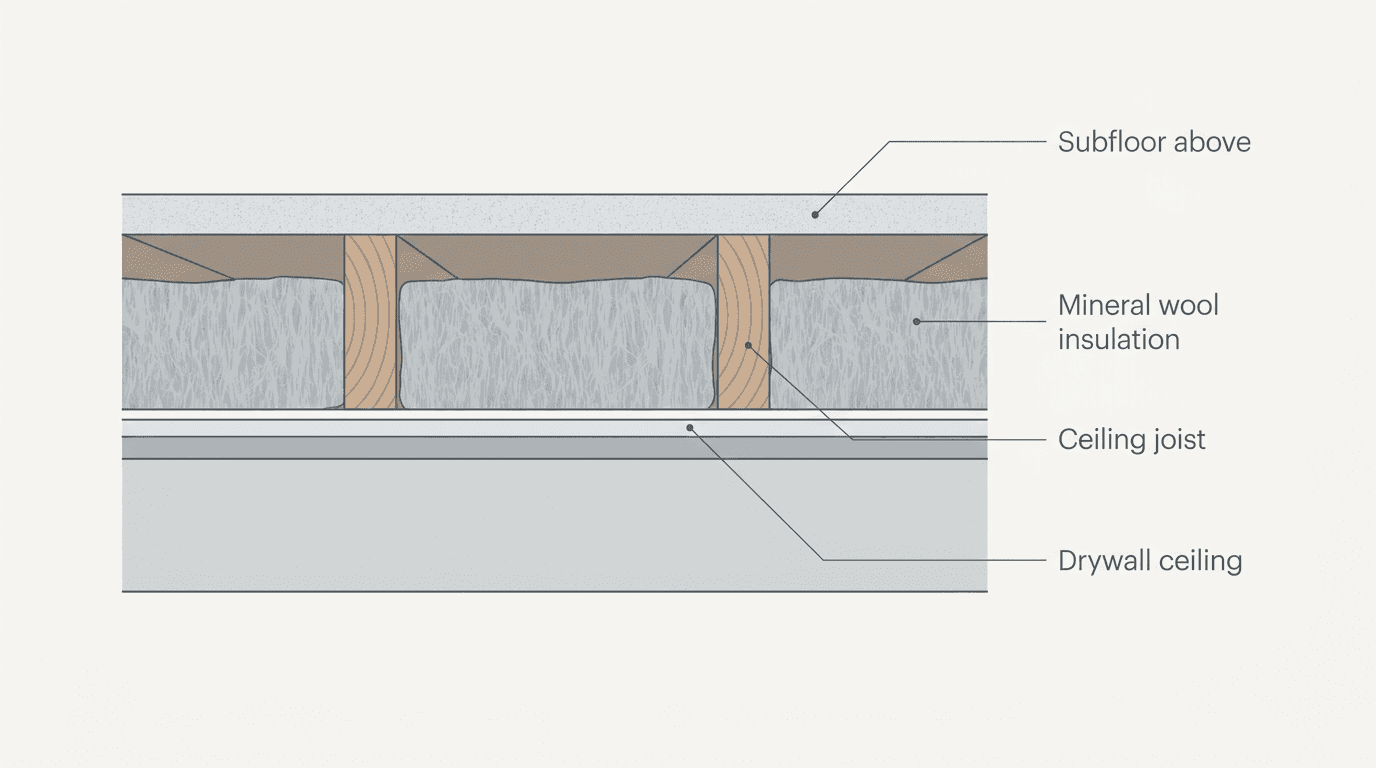
The starting point for almost every quiet basement is Roxul Safe'n'Sound, a dense mineral-wool batt that gets packed between the ceiling joists (and sound-sensitive walls). It absorbs airborne sound — voices, TV, music — far better than standard fibreglass, and as a bonus it's fire-resistant and doesn't sag over time.
For the majority of basements, good insulation alone delivers most of the improvement people are looking for. It's the best value in soundproofing, and it's where we start.
Option 2: Resilient channel — the next step up
When you want to go further, the next upgrade is resilient channel. This is a thin, springy metal channel screwed horizontally across the joists; the drywall then attaches to the channel instead of directly to the wood. The effect is that the ceiling is mechanically "decoupled" from the structure above — so impact and vibration (think footsteps) can't travel straight through the framing.
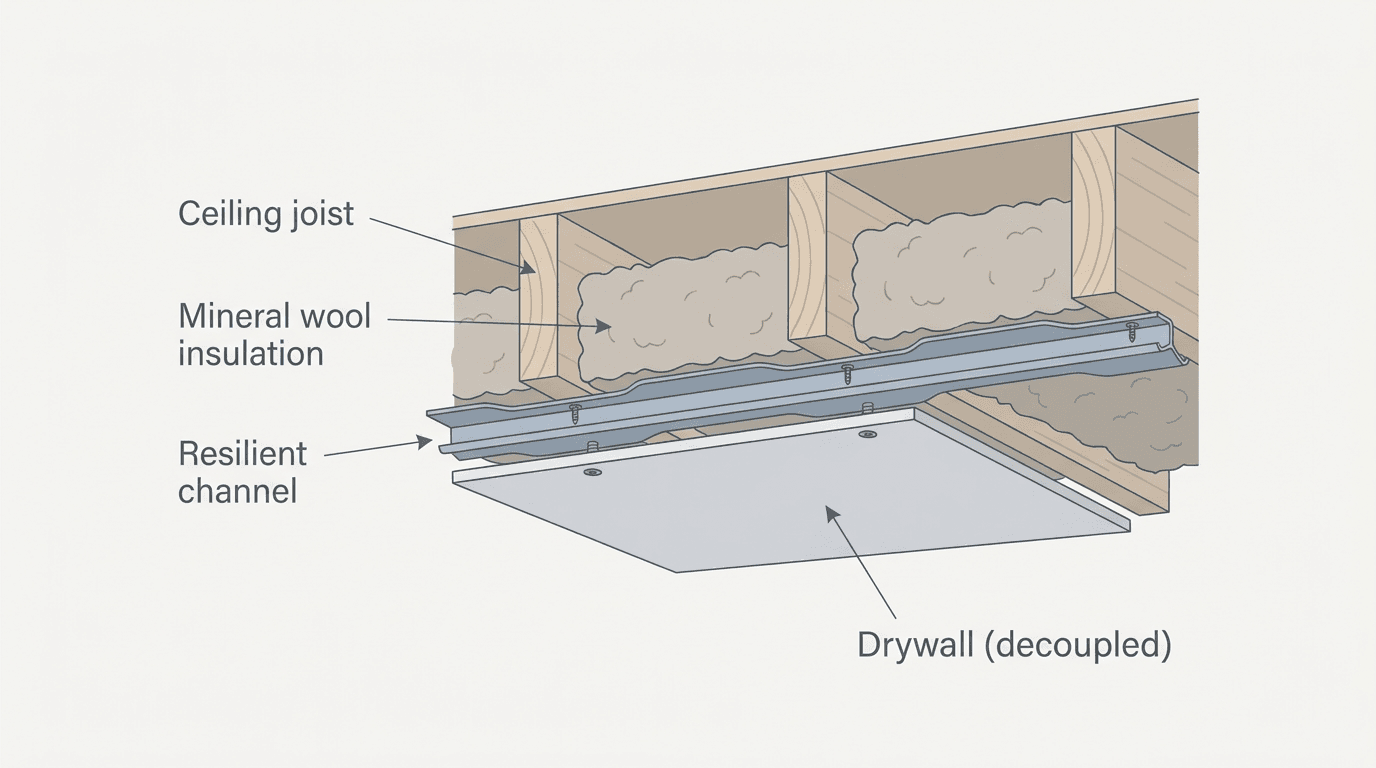
Roxul insulation plus resilient channel is our go-to combination when sound control is a real priority — under a media room, a primary bedroom, or any suite.
Option 3: Double drywall, Green Glue, and acoustic boards — for serious quiet
For the most demanding rooms — a drummer's practice space, a serious home theatre, or a rental suite where you want maximum separation — you step up to two layers of drywall, often with a viscoelastic damping compound like Green Glue sandwiched between them. The extra mass plus the damping layer kills a remarkable amount of sound transfer.
Beyond that, the market offers specialized acoustic drywall and sound-rated boards for situations where you want the highest performance in the thinnest assembly. These are overkill for an average rec room, but they earn their place in the right project.
How to choose: match the method to the room
The biggest mistake is treating the whole basement the same. A guest bedroom and a home theatre have completely different needs. A smart sound plan might look like:
- Rec room / general living: Roxul in the ceiling.
- Media room or primary bedroom below: Roxul + resilient channel.
- Drum room / home theatre / rental suite: Roxul + resilient channel + double drywall with Green Glue.
This room-by-room approach is exactly how we design it — so you invest in quiet where it matters and don't overspend where it doesn't. (For legal suites, some sound separation is also tied to fire-separation code requirements, which we build to regardless.)
What does basement soundproofing cost?
Cost scales with how far up the ladder you go: insulation is the most affordable layer, resilient channel adds a moderate amount, and double-drywall-plus-damping is the most involved. Because every basement and every room is different, the honest answer is that your exact cost is confirmed in a fixed-price quote — but the relative order above holds true every time. The cheapest way to get it wrong is to skip it now and try to add it later.
Frequently asked questions
Is insulation alone enough to soundproof a basement?
For most rec rooms and living spaces, dense mineral-wool insulation like Roxul in the ceiling makes a big, noticeable difference on its own. If you have a specific noise concern — a tenant, a theatre, a drummer — that's when you layer on resilient channel or double drywall.
What's the difference between Roxul and regular fibreglass insulation?
Roxul (mineral wool) is denser than standard fibreglass, which makes it better at absorbing sound, and it's also fire-resistant and holds its shape over time. It's our default for sound-sensitive areas.
Can you soundproof a basement after it's already finished?
You can, but it's far more expensive and disruptive, because the ceiling and walls have to be opened back up. The big savings come from planning soundproofing into the original build — which is one more reason to finish a basement with a team that designs it properly the first time.