
Permits & Legal Suites
In-Law Suite vs Legal Secondary Suite: What's the Difference?
By Kloe Bay · June 10, 2026
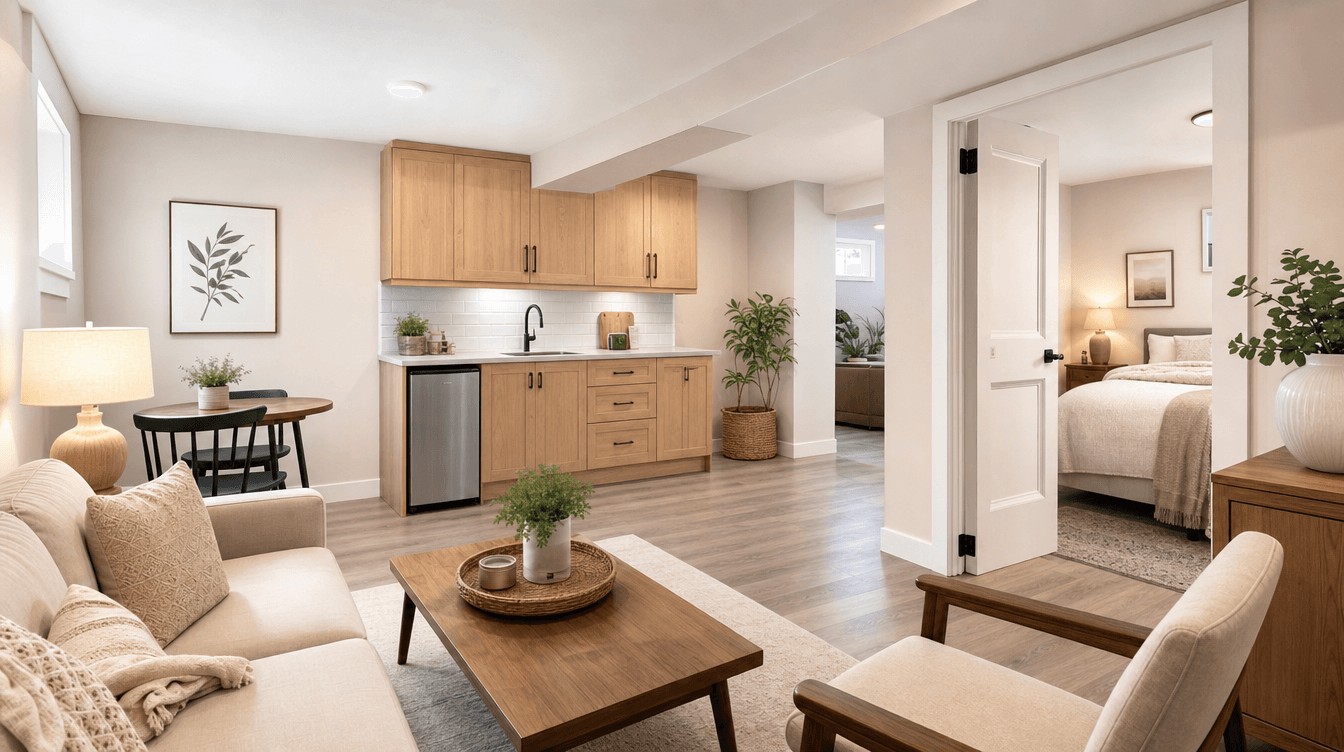
In-law suite vs legal secondary suite — what actually separates them in Calgary, when a family space still has to meet suite code, and why it matters.
The difference between an in-law suite and a legal secondary suite is that 'legal secondary suite' is a defined, code-regulated dwelling, while 'in-law suite' is just an informal description of a basement space set up for family — and the moment an in-law space becomes truly self-contained, the city treats it as a secondary suite that must meet suite code. One is a legal category, the other is a use, and they overlap exactly when a family space crosses into being an independent dwelling. Here's what separates them and why it matters for safety, permits, and resale. (This is general information; we confirm what applies to your exact address.)
What a legal secondary suite is
A legal (registered) secondary suite is a self-contained dwelling within a house, built and permitted to code. To qualify, it needs the full set of requirements:
- A separate entrance independent from the main home.
- Its own kitchen and bathroom.
- An egress window in every bedroom.
- Fire and smoke separation between the suite and the main dwelling.
- Independent heat.
There's no maximum floor area for a basement suite. When it's permitted and registered, it's recognized by the city and can be legally rented. For the full picture, see our legal basement suite in Calgary guide.
What an 'in-law suite' actually means
'In-law suite' is not a building-code term. It's an everyday phrase for a basement area designed so a family member — aging parents, an adult child — can live comfortably. In practice it lands somewhere on a spectrum:
- A shared arrangement — a bedroom, bathroom, and sitting area that still shares the home's main kitchen and entrance. This is part of your home, not a separate dwelling.
- A fully self-contained space — its own kitchen, entrance, and systems, lived in independently. This is a secondary suite in everything but name.
The label describes who it's for; it says nothing about whether it meets code.
When a family space must meet suite code
Here's the part that catches people out: the city cares about what the space is, not who lives in it. If an in-law space becomes a self-contained dwelling — most importantly, its own kitchen plus a separate entrance — it's a secondary suite, and it must meet suite requirements and be permitted, even if only family will ever live there. Framing it as 'just for mom' doesn't exempt it from egress, fire separation, or permits. A full second kitchen is often the deciding feature that tips a space from 'family room with a bed' into 'suite.'
Why the difference matters
- Safety. Egress windows and fire separation exist so anyone in the basement — family included — can get out in an emergency.
- Insurance. An unpermitted, non-code suite can create problems with a claim, whatever the intent.
- Resale. A properly permitted suite is an asset a buyer values; an unpermitted one is a liability that can complicate a sale.
How we approach it
ReImagine builds these spaces right from the start, as part of a full basement development — we design for how your family actually lives, and where the space is truly self-contained, we build it to legal-suite standard with the permits, egress, separation, and systems in place. We don't retrofit or 'legalize' an existing finished basement; we build it correctly the first time. If you're weighing a family space, start with a free quote and see our basement rec room ideas for design inspiration.
Is an in-law suite the same as a legal secondary suite?
Not necessarily. 'In-law suite' is an informal term for a basement space set up for family; 'legal secondary suite' is a code-defined, permitted, self-contained dwelling. They're the same thing only when the in-law space is fully self-contained — its own kitchen and entrance — in which case it must meet suite code.
Does a suite for family still need to be legal?
If it's a self-contained dwelling with its own kitchen and separate entrance, yes — the city treats it as a secondary suite regardless of who lives in it, so it needs permits, egress, fire separation, and independent heat. A shared arrangement without its own kitchen is generally part of your home instead.
What turns a family basement into a 'suite' in the city's eyes?
Being self-contained — most often a full second kitchen plus a separate entrance, lived in independently. That combination is what typically makes it a secondary suite that must meet code.