
Cost
Basement Cost Breakdown: Where Every Dollar Goes
By Bo Fric · September 19, 2025
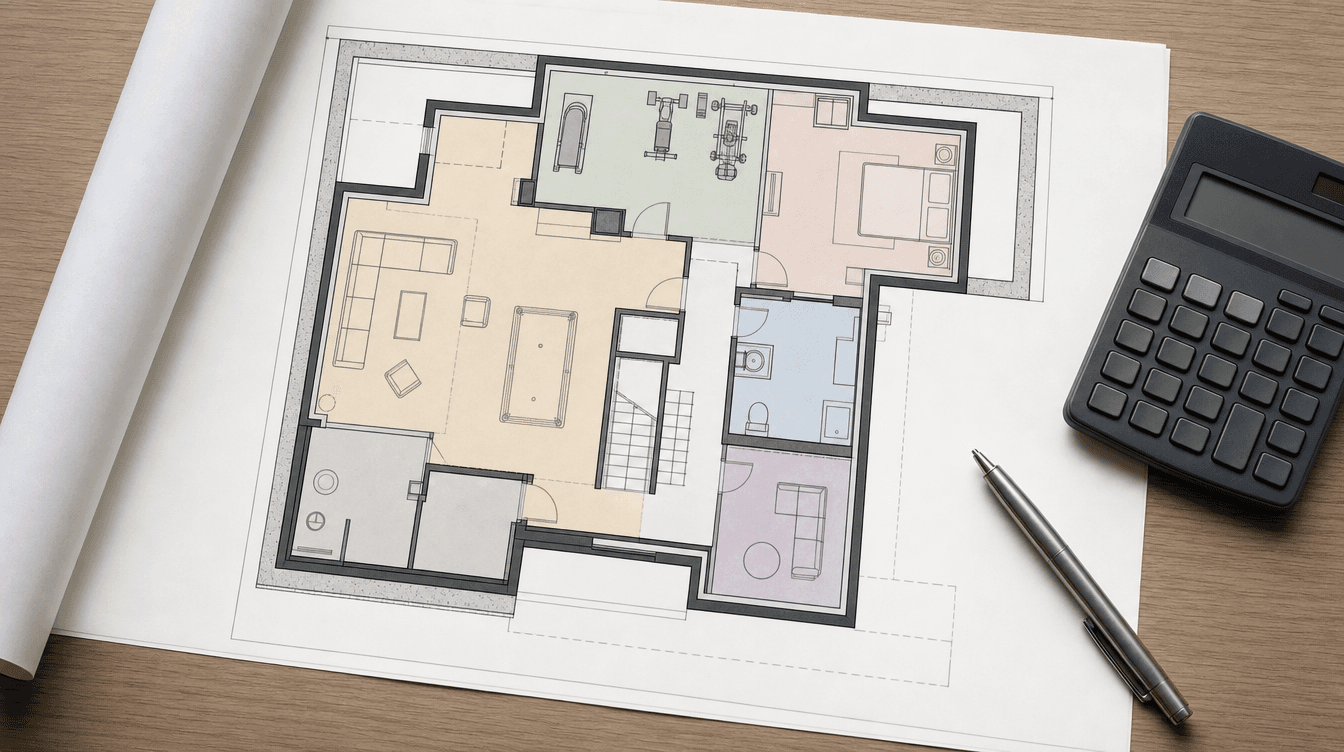
A basement cost breakdown showing where every dollar goes — the trades and rooms that carry the budget, and why bathrooms and mechanicals cost more than open space.
A basement's cost isn't spread evenly across the floor — it concentrates in a few areas: the wet rooms (bathrooms, kitchens, bars), the hidden mechanical work, and finishes spread over the whole space, while big open rooms are the cheapest per square foot. Understanding this breakdown is what makes a basement price make sense. Here's where every dollar goes. (All figures here are relative; your exact price comes in a fixed-price quote.)
The heavyweights: bathrooms, kitchens, and bars
The single biggest driver is the "wet" rooms, because they pack expensive work into small footprints:
- Bathrooms — plumbing, drainage/rough-in, waterproofing, tile, fixtures, and ventilation, all in one small room. Per square foot, it's the most expensive space in the basement.
- A kitchen or [wet bar](/blog/basement-bar-kitchen-cost) — plumbing, cabinetry, appliances, and electrical stacked together.
If your basement has two bathrooms and a kitchen, those rooms alone carry a large share of the total.
The hidden work: mechanical and structural
Behind the walls sits a real, unavoidable portion of the budget:
- Electrical — the wiring, panel load, and circuits.
- HVAC — heating and air changes to serve the new space.
- [Insulation](/blog/insulate-basement-walls), framing, and waterproofing — the bones and the moisture protection.
You never see this work, but it's the part a quality builder never cuts.
Finishes: modest each, meaningful together
Across the whole basement, finishes add up:
- Flooring, drywall, paint, and trim.
- Doors, hardware, and [lighting](/blog/basement-lighting-no-windows).
- The [finish tier](/blog/basic-vs-high-end-basement) you choose — standard vs. premium — quietly moves this whole category.
Individually small, but spread over the square footage, finishes are a significant slice.
The cheapest part: open living space
Here's the surprise: the big open rec room or living area is the least expensive per square foot. It's a lot of floor with relatively little packed into it — flooring, a bit of lighting, and paint. This is why per-square-foot pricing is misleading: the open space drags the average down while the wet rooms push it up.
Why the total sometimes surprises people
When a basement price is higher than someone expected, it's almost always the bathrooms, kitchen, and mechanical work doing the heavy lifting — not the open space they were picturing. That's exactly why we price the actual scope and show you the breakdown, as part of a full basement development, rather than a single vague number.
What costs the most when finishing a basement?
The wet rooms — bathrooms, kitchens, and wet bars — because they pack plumbing, waterproofing, tile, fixtures, and ventilation into small footprints. Per square foot, a bathroom is the most expensive space. Hidden mechanical work (electrical, HVAC, insulation) is next, while open living space is the cheapest.
Why is a basement bathroom so expensive?
Because it concentrates a lot of costly work into a small area: plumbing and drainage (often the hardest part in a basement), waterproofing, tile, fixtures, cabinetry, and ventilation. That density of trades and materials makes it the most expensive room per square foot, which is why the number of bathrooms strongly affects the total.
Where can you save money in a basement budget?
On the visible, swappable finishes — mid-range flooring, cabinets, and fixtures — and by keeping open, simple layouts. Never save on the hidden, structural work (waterproofing, electrical, framing, insulation) or permits. Spending where it's hidden and saving where it's visible is how you build an affordable basement without regrets.