
Permits & Legal Suites
What Makes a Basement Bedroom Legal?
By Kloe Bay · January 29, 2026
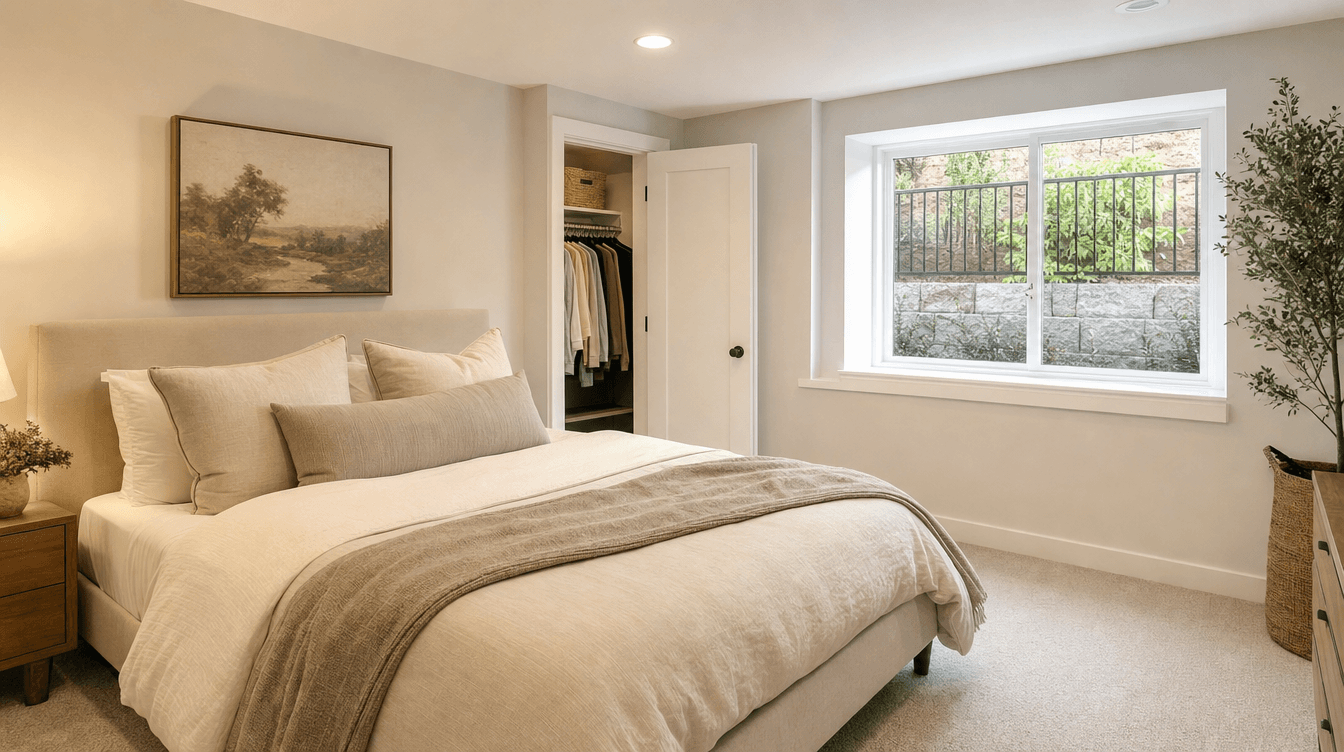
What makes a basement bedroom legal — the egress window, ceiling height, smoke alarm, and other code requirements that separate a real bedroom from just a room.
There's a real difference between a room with a bed in it and a legal basement bedroom — one the building code recognizes. The defining requirement is an egress window (big enough to escape through), plus adequate ceiling height, an interconnected smoke alarm, proper heat and light, and usually a closet. It matters for both safety and resale. Here's what makes a basement bedroom legal. (This is general information; exact current requirements are confirmed against code for your project.)
1. An egress window (the big one)
The most important — and most often missed — requirement is an egress window:
- Large enough for a person to climb out in a fire, and for a firefighter to climb in.
- Non-negotiable — it's fundamentally about escaping safely in an emergency.
Most existing basement windows are too small, so a legal bedroom often requires cutting in a proper egress window. No egress window, no legal bedroom — it's that simple.
2. Adequate ceiling height
The room needs enough finished [ceiling height](/blog/basement-ceiling-height-code) to count as habitable space under the code. This is measured on the finished height, not the raw slab-to-joist, so the floor and ceiling assembly matters.
3. An interconnected smoke alarm
A legal bedroom needs a [smoke alarm](/blog/basement-smoke-co-alarms) in the room, interconnected with the rest of the home, so a fire anywhere sounds every alarm and wakes the occupant. It's a core life-safety requirement.
4. Heat, light, and (usually) a closet
Rounding out the requirements:
- Proper heat to the room.
- A means of light and ventilation — the egress window typically helps here.
- A closet, commonly expected for a room to be marketed and counted as a bedroom.
Why it matters for resale, not just safety
Beyond safety, there's a resale reason this matters: a room only counts as a bedroom when it's a legal bedroom. Marketing a "3-bedroom basement" when those rooms lack egress is a problem — a buyer's home inspector will flag it, and it can derail a sale or force a correction. A legal bedroom is a countable, sellable bedroom, which ties directly into whether the basement adds value. Build it to the requirements — to code and inspected — and it's the real thing, as part of a full basement development.
What makes a basement bedroom legal?
The defining requirement is an egress window large enough to escape through in a fire (and for a firefighter to enter), plus adequate finished ceiling height, an interconnected smoke alarm in the room, proper heat, a means of light and ventilation, and usually a closet. Without an egress window especially, a basement room is not a legal bedroom.
Can a basement room without a window be a bedroom?
No — a legal bedroom requires an egress window sized for emergency escape and rescue. A room without one may be usable as an office, gym, or den, but it can't legally be called or counted as a bedroom. Creating a legal bedroom usually means cutting in a proper egress window, since most existing basement windows are too small.
Does calling a basement room a bedroom affect resale?
Yes. A room only counts as a bedroom for resale when it's a legal bedroom — meeting egress, height, alarm, and related requirements. Marketing rooms as bedrooms when they lack egress is a common problem a buyer's inspector will catch, which can derail a sale. Legal bedrooms are countable and add genuine, defensible value.