
Design & Room Types
Designing the Perfect Basement Home Gym
By Oscar Fonseca · July 22, 2025
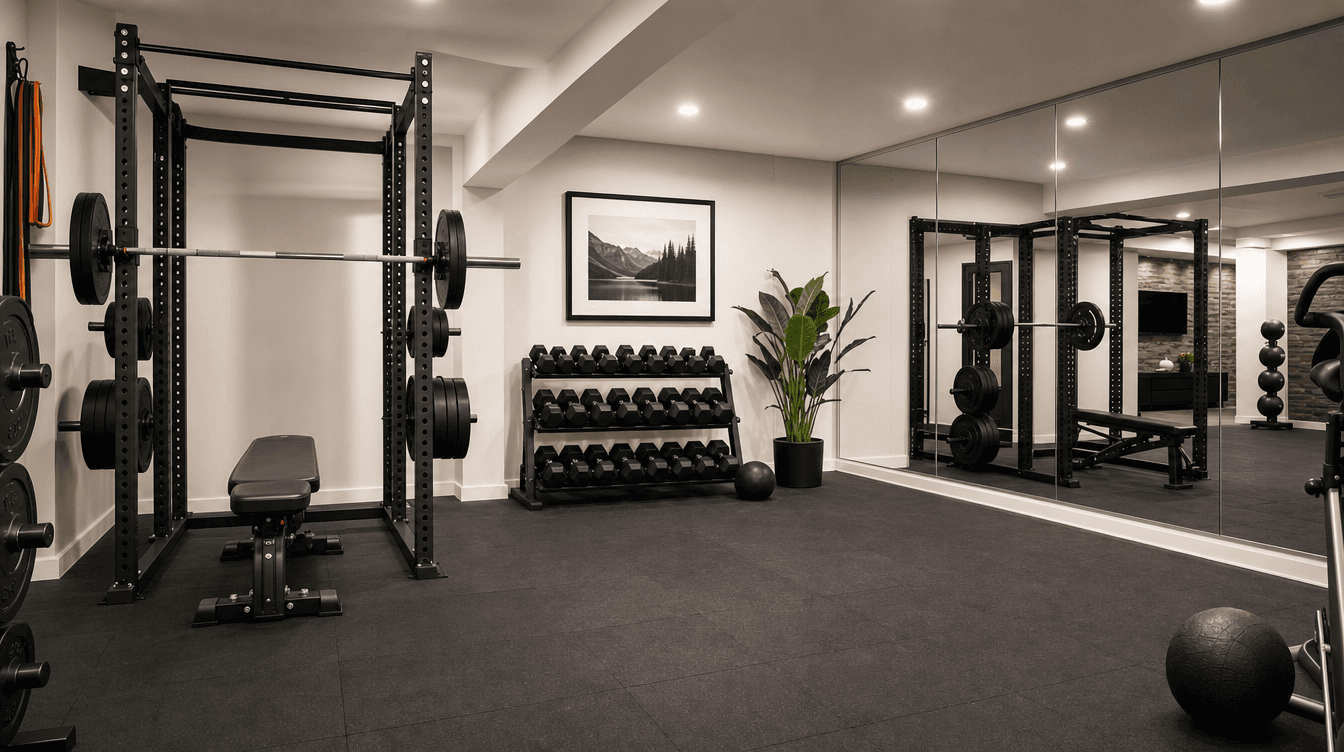
How to design the perfect basement home gym — flooring, ceiling height, mirrors, ventilation, and lighting — and the details to plan in before you build.
Designing a basement home gym you'll actually use comes down to five things: the right flooring, enough ceiling height, mirrors, proper ventilation, and bright lighting. Get those right and the basement becomes a genuine gym rather than a room where equipment collects dust. Here's how to plan each one — ideally before you build. (Design guidance here is general; we tailor it to your space and show it to you first.)
Flooring: the one you can't skip
Gym flooring is the foundation of the room, literally and figuratively. Heavy-duty rubber flooring is the standard because it:
- Protects the concrete slab from dropped weights.
- Absorbs impact and cuts noise transfer to the rest of the house.
- Grips underfoot and makes the space feel like a real gym.
This sits on top of the base floor assembly — see how the subfloor and flooring work together — so it's worth planning as part of the build.
Ceiling height: plan for the movements
Height is a real constraint below grade. Overhead presses, pull-ups, box jumps, or a tall piece of cardio equipment all need clearance. We plan mechanical runs to preserve every inch and flag early if a particular movement won't fit under the ceiling, the same care that goes into designing around a low ceiling.
Mirrors: form and light
Mirrors do double duty in a basement gym:
- They help your form during lifts and movements.
- They bounce light and visually double the space, which is a big deal in a room with limited natural light.
A well-placed mirror wall is one of the highest-impact, lowest-cost moves in a basement gym.
Ventilation: the detail people forget
A gym heats up and gets humid fast, and in a basement that moisture has to go somewhere. Good airflow — proper HVAC supply and return, and often a dedicated fan — keeps the room comfortable and keeps humidity from becoming a moisture problem. It's the same reason heating and air handling deserve real attention in any finished basement.
Lighting: bright and energizing
Finally, light the room brightly and evenly. A dim gym is a gym you avoid. Layered, high-output lighting keeps the space feeling energizing rather than like a dark corner — part of the broader art of making a basement feel less like a basement.
What flooring is best for a basement home gym?
Heavy-duty rubber flooring is the standard. It protects the concrete slab from dropped weights, absorbs impact, reduces noise transfer to the rest of the house, and gives the room a real-gym feel underfoot. It's installed as part of the floor assembly, so it's best planned into the build.
How much ceiling height do you need for a basement gym?
Enough for the movements you'll do — overhead presses, pull-ups, or box jumps need real clearance, as does tall cardio equipment. Because height is limited below grade, we plan mechanical runs to preserve every inch and flag early if a specific movement won't fit under your ceiling.
Does a basement gym need special ventilation?
Yes — a gym warms up and gets humid quickly, and in a basement that moisture needs somewhere to go. Proper HVAC supply and return, often with a dedicated fan, keeps the room comfortable and prevents humidity from turning into a moisture problem. It's an easy detail to plan in and a costly one to ignore.