
Materials & Suppliers
Pot Lights in a Basement: A Practical Guide
By Josh Wallace · October 20, 2025
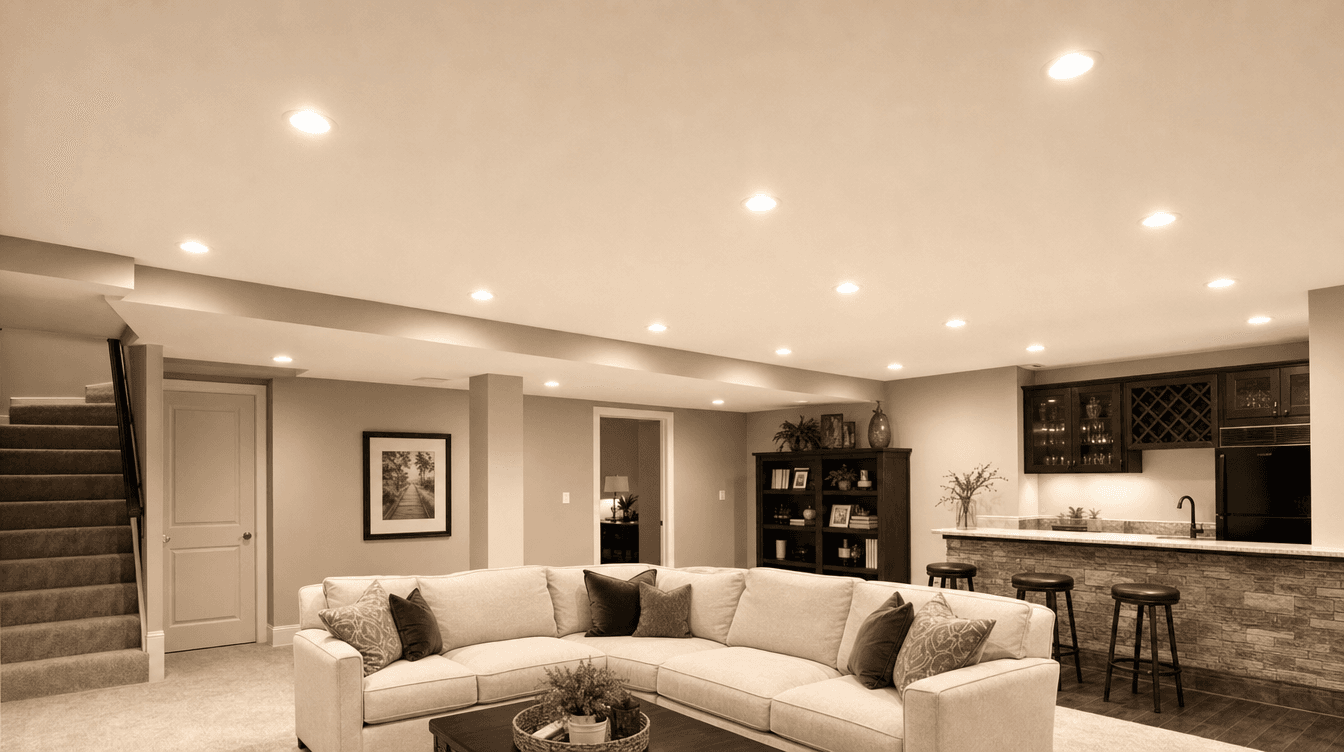
Pot lights in a basement — why recessed lighting is the go-to for low ceilings, how layout and spacing work, and what to know about the wiring behind them.
Pot lights (recessed lights) are the workhorse of basement lighting, and for good reason — they sit flush in the ceiling, throw even light, and don't steal precious head height. But a good pot-light job is more than poking holes in the drywall. Here's a practical guide to how they work in a basement. (This is general construction guidance; the right plan for your basement is confirmed during the build.)
Why pot lights suit a basement
Recessed lighting is popular below grade because it solves the two big basement problems:
- They preserve head height — nothing hangs down, which matters in a low ceiling.
- They light evenly — a grid of pot lights fills a windowless space with consistent light, the foundation of good basement lighting.
That combination is why they're the default choice for most of a finished basement.
Layout and spacing matter
Good recessed lighting is planned, not scattered:
- A thought-out grid spaces the lights so there are no dark patches or harsh hot spots.
- Task areas get extra — over a bar, kitchenette, or workspace.
- Zones and dimmers let one open space shift from bright to cozy — the same zoning logic used throughout.
Spacing is a design decision that makes the difference between a flat, evenly-lit room and one that feels intentional.
LED is the standard now
Modern pot lights are almost always LED:
- Slim housings fit even tight ceiling cavities — handy when there's a bulkhead or ductwork above.
- Efficient and long-lasting, so you're not changing bulbs in a high ceiling.
- Colour temperature matters — a warm-ish white keeps a basement feeling cozy rather than clinical, part of the overall finish palette.
The part you don't see: the wiring
Here's what separates a proper job from a risky one: the wiring behind pot lights is electrical work that must be done to code, permitted, and inspected. Recessed fixtures sit inside the ceiling near insulation and framing, so they have to be installed and wired correctly — it's part of the electrical rough-in that gets inspected before the ceiling closes up. This is exactly the kind of work to leave to licensed pros.
The takeaway
Pot lights are the right call for most of a basement — they save head height and light evenly — but a great result comes from a planned layout, LED fixtures, the right colour temperature, and proper, permitted wiring. Done well, they're what makes a finished basement feel bright and intentional, as part of a full basement development.
Are pot lights good for a basement?
Yes — recessed pot lights are the go-to for basements because they sit flush in the ceiling (preserving precious head height in a low space) and throw even light across a windowless room. Planned as a thought-out grid with dimmable zones and warm-white LEDs, they're what makes most finished basements feel bright and intentional rather than flat or dim.
How many pot lights does a basement need?
It depends on the size, layout, and ceiling height, so it's planned as a grid rather than a fixed number — spaced to avoid both dark patches and harsh hot spots, with extra lights over task areas like a bar or workspace. The right count and spacing are a design decision made for your specific space, not a one-size number.
Do basement pot lights need a permit?
The wiring behind them does. Recessed lights are electrical work installed inside the ceiling near insulation and framing, so they must be wired to code, permitted, and inspected as part of the electrical rough-in before the ceiling is closed up. It's exactly the kind of work to leave to licensed professionals rather than DIY, for both safety and compliance.